Charis Conference 2026
Fill a conference with registrations in three weeks – for an audience you can't pick from a targeting menu.
Charis is a five-day Christian conference at the Brno Exhibition Centre (8–12 July 2026) with a programme for adults and children. The brief: drive as many website registrations as possible in the last three weeks before the event.
- A fixed date. The day after the conference the campaign is worth nothing – no “we'll catch up next month”. It had to learn and deliver at the same time.
- A limited budget. Every creative without results hurts; there was no room for long test phases.
- An audience defined by values, not demographics. Age, city or any interest Meta offers as a parameter doesn't describe who attends.
- Registration on a different domain. The conference site and the registration form run on two separate systems. Without shared tracking Meta couldn't see who actually registered.
Tracking first, then open targeting steered by the creative.
- Cross-domain tracking. Together with the web team and the registration-system vendor I got Google Tag Manager and the Meta Pixel onto both domains and set the Lead conversion on a completed registration. The campaign learned from real registrations, not clicks.
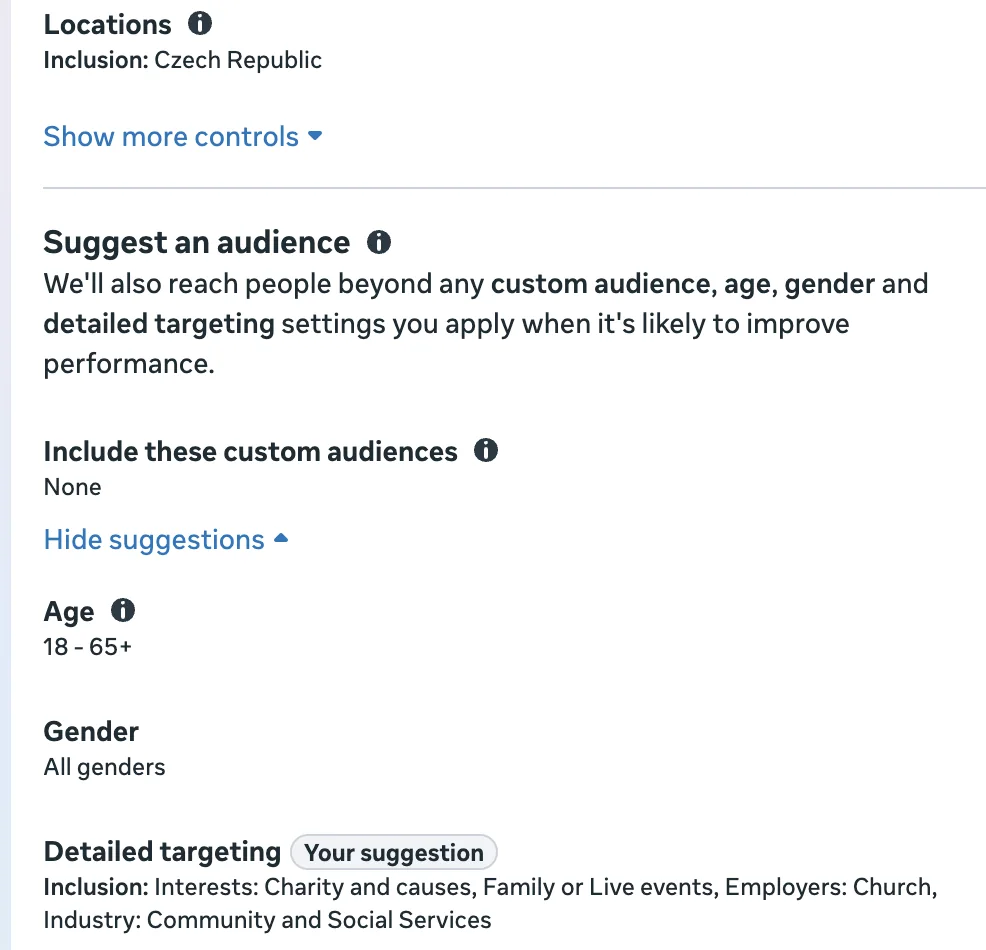
- Advantage+ with open targeting across the Czech Republic. Instead of narrow interest audiences, the algorithm got signals (charity, family, live events, church) as a suggestion, not a restriction. Splitting a small budget into five ad sets would have meant none of them could learn.
- 12 creatives mapped to decision stages (See–Think–Do): testimonial videos for trust, a programme static for concrete information, and urgency creatives (“2nd wave”, “last chance”) for action.
- Ongoing reports for the organisers: what works, what I'm pausing and why.
- website registrations
- 198
- unique people
- 33,150
- impressions
- 128,595
- top creative CTR
- 14.36%
Tracking: without registration data it's a lottery
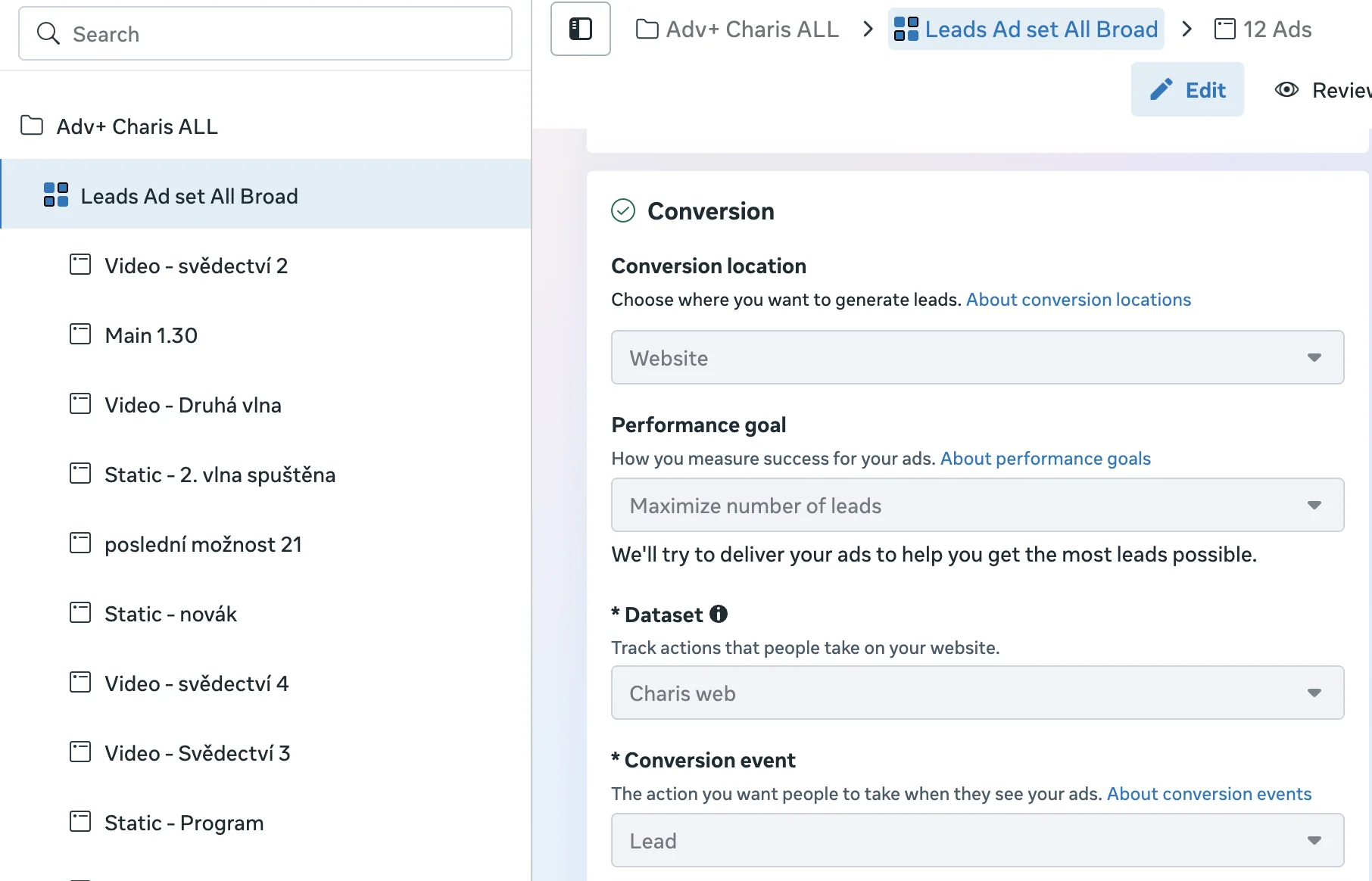
The registration form didn't live on the conference website but on the vendor's separate domain. Had the pixel only covered the main site, Meta would have seen visits but not registrations – and optimised for people who like to click. So I sorted out GTM on both domains first and only then launched the campaign with the Leads objective, the “Charis web” dataset and the Lead conversion event.
Targeting: when you can't target, let the creative do it
The campaign ran on Advantage+ across the Czech Republic, ages 18–65+. Interests were only entered as an audience suggestion. Meta uses them to start, but may go beyond them wherever it finds people who register. That made the creative the real targeting tool: whoever responds to a testimonial video defines who Meta shows the next ad to.
Creatives: three appeals, three stages
The creatives were shot and designed by the conference's production team. I selected them, mapped them to funnel stages and tested them against each other.
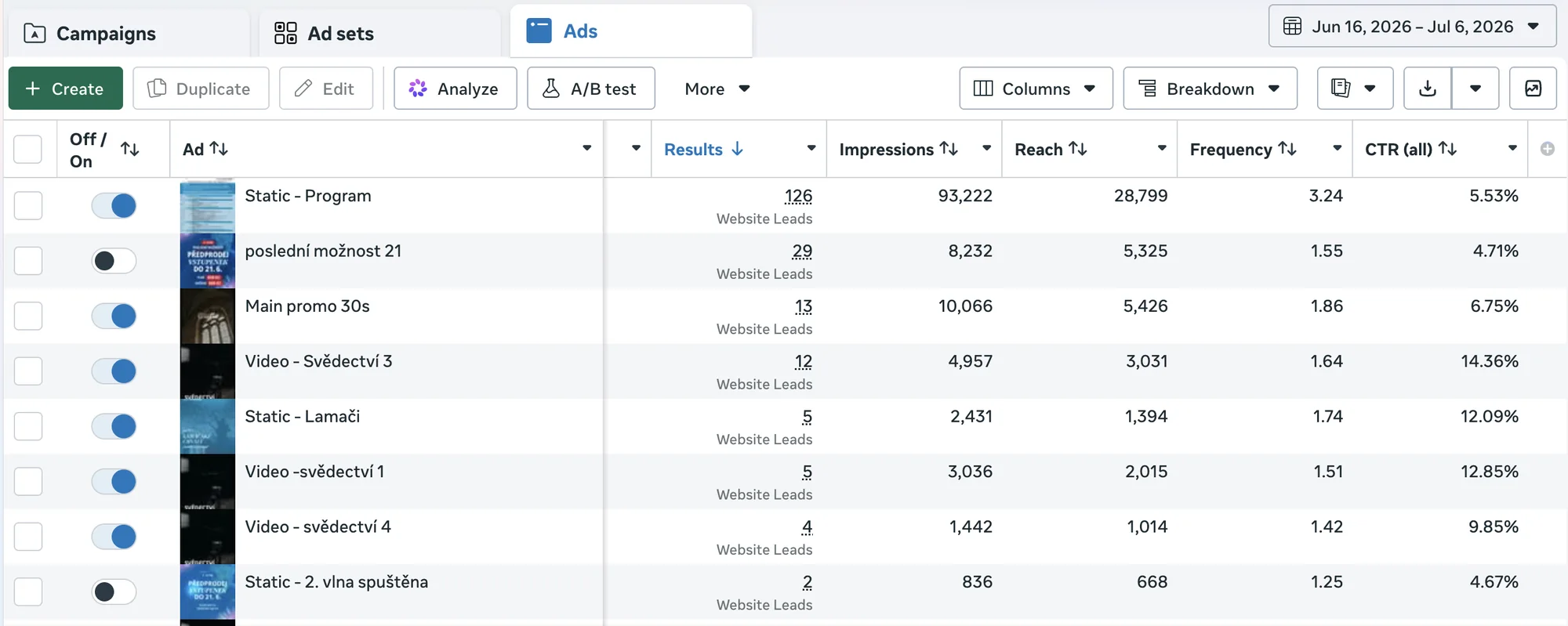
- Emotion – testimonial videos (Bishop Pavel Konzbul, Sister Faustyna, attendees). The highest CTR of the whole campaign, up to 14.36%. They build trust with people who don't know Charis.
- Reason – the programme static. The volume driver, bringing 126 registrations on its own.
- Urgency – “2nd wave is live”, “last chance”. The “last chance” creative was the most efficient ad of the entire campaign.
The key lesson: video opens, static closes. Statics brought 82% of registrations, but without the videos they would have been talking to people with no reason to trust the conference. That's why I didn't switch the videos off just because they didn't collect many registrations themselves.
Timeline: the deadline was the strongest lever
The first week brought 116 registrations thanks to a fast start. The second week slowed down. Then the “last chance” urgency creative went live and the final week added another 59 registrations – on a fraction of the first week's budget. Cost per registration in the final week dropped to roughly a third.
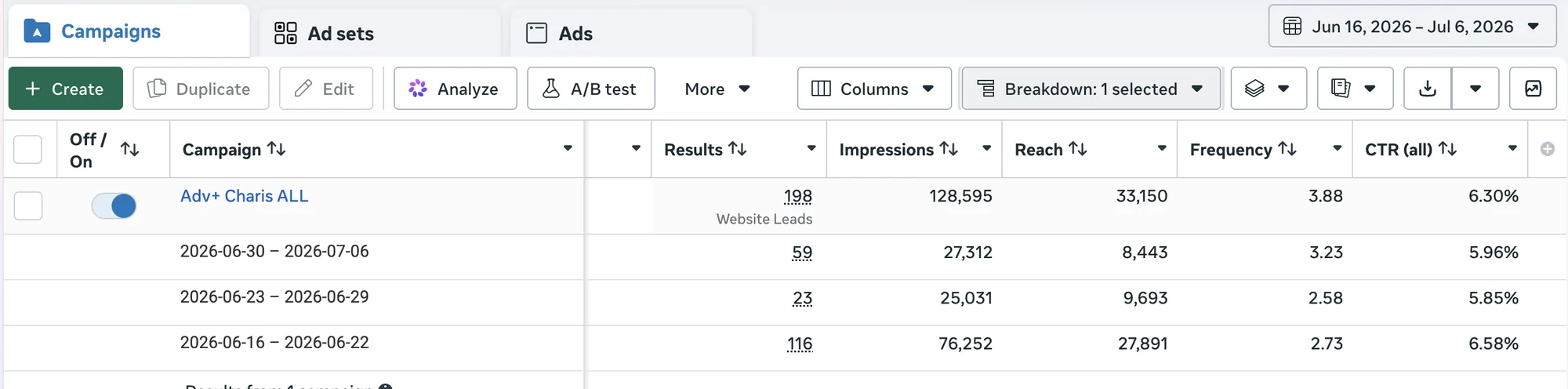
A frequency of 3.9 means each of the 33 thousand people reached saw Charis almost four times on average. Beyond the registrations, the campaign built strong awareness and an audience the next edition can retarget from day one.
What I'd do differently next time
- Flip the budget curve – more at the end, where registrations were cheapest.
- Urgency in waves, not just as a finale: “2nd wave” → “last X places” → “registration closes tomorrow”.
- Retargeting for people who watched a video or visited the website.
- Native 9:16 creatives for Instagram. Instagram got graphics repurposed from Facebook, and it showed.
- Measure all the way to attendance, not just registration. The goal is a full hall, not a filled-in form.